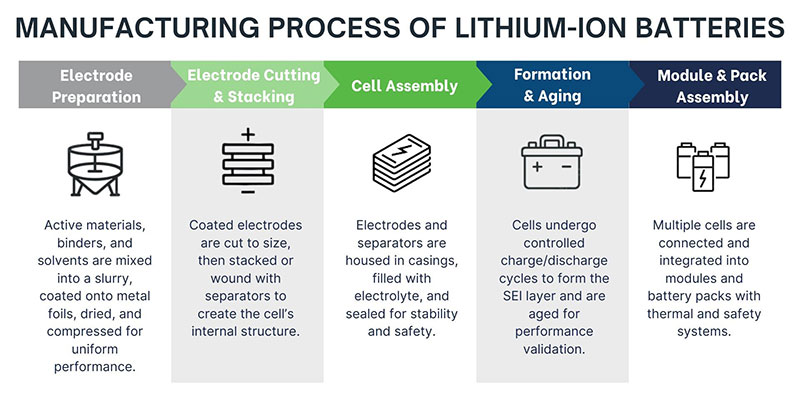
Lithium-ion battery manufacturing is a complex process that requires precision and safety at every step. Fluid handling is critical in ensuring high-quality battery production, from handling corrosive electrolytes to preparing viscous slurries and managing hazardous waste. Selecting the right fluid handling equipment can improve efficiency, reduce downtime, and protect operators. Cole-Parmer offers a comprehensive portfolio of fluid handling products designed to meet the demanding requirements of battery manufacturing.
Key Fluid Handling Challenges & Solutions in Lithium-Ion Battery Production
Lithium-ion battery manufacturing presents several fluid handling challenges. Addressing these challenges requires reliable solutions, from chemically compatible components to leak-resistant connections, ensuring operator safety, consistent product quality, and efficient production.
Electrolyte Handling
Liquid electrolytes are precisely dosed into battery cells to enable ion transfer between the anode and cathode. These materials are typically flammable, corrosive, and sensitive to contamination.
- Challenge: Electrolytes require precise dosing, leak-free transfer, and chemical compatibility to maintain safety and quality.
- Solution: Use peristaltic pumps for precise dosing and chemically resistant tubing and components for safe delivery and contamination-free handling.
Slurry and Coating Processes
Electrode slurries, made from active materials, binders, and solvents, are mixed and coated onto metal foils for the battery electrodes. Viscosity and particle load make consistent handling difficult.
- Challenge: Thick, particulate-laden slurries can clog systems and cause coating inconsistencies.
- Solution: Select high-torque peristaltic pumps with large bore, abrasion-resistant tubing to maintain uniform flow and prevent blockages.
Cleaning and Rinsing Operations
Manufacturing lines are frequently flushed with solvents or deionized water to prevent cross-contamination between batches. This requires durable, solvent-compatible systems.
- Challenge: Aggressive cleaning agents can degrade tubing and fittings, leading to leaks and downtime.
- Solution: Use tubing, such as TPV, compatible with clean-in-place (CIP) solutions, paired with quick-disconnect fittings for rapid system changeover.
Waste and Solvent Management
Spent electrolytes, solvents, and rinse water must be collected and disposed of in compliance with environmental and safety regulations.
- Challenge: Hazardous liquids must be transferred without spills, leaks, or operator exposure.
- Solution: Implement closed transfer systems with chemical-resistant valves, secure fittings, and sealed waste containers.
Essential Fluid Handling Equipment
Peristaltic Pumps
In lithium-ion battery manufacturing, peristaltic pumps provide precise, repeatable flow control for electrolytes, slurries, and solvents. Their design isolates the fluid in the tubing, reducing contamination risks and simplifying cleaning.
Tubing
Tubing is the backbone of fluid transfer systems, and material compatibility is essential for handling electrolytes, slurries, and cleaning solvents without degradation. The right tubing minimizes downtime, reduces leaks, and ensures product purity. Cole-Parmer offers a range of tubing engineered for chemically corrosive and harsh environments.
Valves and Fittings
Leak-free connections are vital to maintaining safety and preventing costly chemical spills during electrolyte transfer, slurry coating, and cleaning. High-quality valves and fittings allow quick line changes, reduce downtime, and support scalable production needs. Cole-Parmer offers multiple connection styles to match different process requirements.
Flow Meters and Pressure Sensors
Monitoring flow and pressure ensures consistent slurry coating, accurate electrolyte dosing, and safe operating conditions. Real-time feedback lets operators detect issues before they affect quality or cause downtime. Cole-Parmer offers monitoring solutions that integrate easily into both automated and manual setups.
Filtration Solutions
Filtration removes particulates from slurries, solvents, and rinse water to protect pumps, sensors, and end-product quality. In-line filters prevent clogging and ensure that coatings and electrolyte formulations remain consistent. Cole-Parmer In-Line Filters effectively remove the particles and impurities found in battery production.
Tips and Tricks for Optimizing Fluid Handling in Battery Manufacturing
- Match the Tubing to the Fluid – Always verify chemical compatibility, pressure rating, and temperature limits to prevent leaks, degradation, or contamination.
- Use Modular Pumping Systems – Modular peristaltic pumps allow easy tubing replacement, quick maintenance, and flexibility for scaling from pilot to full-scale production.
- Implement Real-Time Monitoring – Flow meters and pressure sensors provide early detection of clogs, leaks, or inconsistent flow, ensuring uninterrupted production.
- Minimize Dead Volume – Optimize tubing length, fittings, and layout to reduce fluid waste and prevent cross-contamination.
- Plan for Cleaning and Maintenance – Choose tubing and fittings that are easy to clean or replace, especially when handling multiple chemical types or high-viscosity slurries.
- Use Inline Filtration Strategically – Place filters upstream of sensitive equipment or at points where particulates can cause clogging to protect pumps, sensors, and coatings.
- Maintain Proper Flow Rates – Adjust pump speed and tubing diameter to match fluid properties; avoid excessive shear that can degrade slurries or solvents.
- Train Operators on Safety Protocols – Ensure proper handling of flammable or corrosive fluids, emphasizing leak checks, containment, and appropriate disposal.
- Document System Configurations – Standardized layouts and labeled components simplify troubleshooting and reduce the risk of human error.
- Work with Trusted Suppliers – Cole-Parmer’s portfolio provides tested, compatible fluid handling components that ensure reliability, chemical compatibility, and operational safety.
Cole-Parmer: Your Partner in Battery Manufacturing
Efficient and safe fluid handling is essential to achieving high-quality lithium-ion battery production. Manufacturers can improve precision, reduce downtime, and maintain a safe working environment by selecting the right equipment. Cole-Parmer offers a comprehensive fluid handling portfolio engineered to meet the demands of critical battery processes that manufacturers can rely on.


