


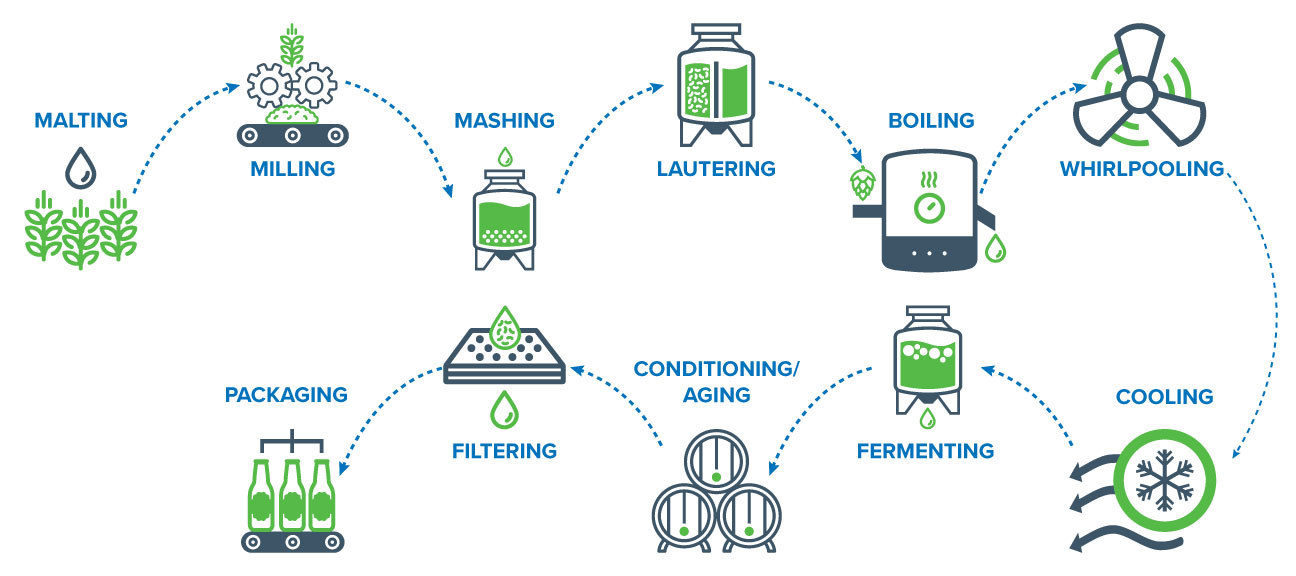

Step 1: Malting
During the malting step, barley or other grains are soaked in water to begin germination. The grain is then dried in a kiln to stop the germination process, producing malt. Malt contains the necessary enzymes for converting starches into sugars.

Step 2: Milling
Malted barley is processed by crushing it into a coarse powder known as grist, which is then added to the mash tun. The milling process is carefully designed to break down the grain kernels while preserving the integrity of the husks for optimal brewing.

Step 3: Mashing
The grist is mixed with hot water to create a mash. This activates enzymes which converts the malt starches into fermentable sugars. The result is a sugary liquid called wort.

Step 4: Lautering
After mashing, the mixture is placed in a lauter tun, where liquid wort drains through slotted plates while grain husks form a filter. The wort is then recirculated to clarify it, and the leftover solids (spent grains) are removed.

Step 5: Boiling
The wort is boiled to sterilize it, and hops are added at different stages to contribute bitterness, flavor, and aroma. During the boil, water evaporates, which helps concentrate the sugars and other components in the wort, enhancing its overall composition.

Step 6: Whirl-pooling
The boiling wort is spun in a whirlpool to separate hop particles and solids from the liquid. This process effectively concentrates the trub into a cone at the vessel's center, making it much easier to remove solids and recover clear, flavorful wort for fermentation.

Step 7: Cooling
The hot wort is quickly cooled to prevent contamination and off-flavors, ensuring optimal conditions for yeast fermentation. Rapid cooling also prevents spoilage by bacteria or wild yeast and avoids undesirable chemical reactions that could impact the final beer.

Step 8: Fermenting
The hot wort is quickly cooled to prevent contamination and off-flavors, ensuring optimal conditions for yeast fermentation. Rapid cooling also prevents spoilage by bacteria or wild yeast and avoids undesirable chemical reactions that could impact the final beer.

Step 9: Conditioning/Aging
Conditioning is the final maturation step, allowing flavors to fully develop and beer to clarify. Carbonation can occur naturally or be added. The conditioning time varies: ales take days to weeks, lagers require 4 to 12 weeks, and high-alcohol beers may take months or even years.

Step 10: Filtration
Filtration removes solids like yeast and hop particles, ensuring clarity and refined taste. Care is taken not to strip desirable flavors. Lagers and pilsners require more filtration for a crystal-clear appearance, while wheat beers and IPAs retain some haze, contributing to their flavor and character.

Step 11: Packaging
Packaging is the final brewing step, where beer is transferred to bottles, cans, or kegs. Ensuring proper carbonation and preventing contamination are crucial. Quality checks for carbonation, clarity, taste, and stability are conducted before packaging. Proper storage afterward preserves the beer’s quality for distribution.

