When working with fluid handling systems, selecting the right fitting impacts everything from flow performance to sterility and ease of maintenance. In Part 1, we covered barbed, compression, and Luer fittings. This article (Part 2 of a 2-part series) dives into three additional common fitting types: quick-disconnect, sanitary, and threaded fittings.
Overview of Different Fitting Types
Each type of fitting has distinct characteristics that make it suitable for different applications:
- Barbed Fittings: Feature ends with ridges that grip tubing securely, often used with hose clamps for added security. Ideal for use with flexible tubing in low-pressure applications that require cost-effective solutions.
- Compression Fittings: Utilize a nut and ferrule to create a strong, leak-proof connection. Best suited for rigid tubing and high-pressure systems.
- Luer Fittings: Standardized small-scale fittings with a conical taper that are available in male and female interlocking configurations. Commonly used in research and laboratory applications.
- Quick-Disconnect Fittings: Enable fast and easy tubing changes with a push-to-connect or latch mechanism. Often used in upstream and downstream bioprocessing setups.
- Sanitary Fittings: Designed for sterile applications, these fittings use clamps and gaskets to ensure contamination-free connections in food and pharmaceutical industries.
- Threaded Fittings: Secure fittings with screw-threaded ends that provide a durable, high-strength connection. Used across industrial, plumbing, and hydraulic systems.
Pros and Cons of Different Fitting Types
| Fitting Type | Advantages | Disadvantages |
| Barbed | Simple installation, cost-effective, widely used and available | Not ideal for high pressure, potential for leaks |
| Compression | Strong, leak-proof, good for high-pressure systems | Requires precise installation, not easily reusable |
| Luer | Standardized, easy to connect, precise fluid control | Limited to low-pressure applications, small bore sizes |
| Quick-Disconnect | Fast changes, minimizes downtime, sterile options, integrated shut-off valve options | Higher cost, may require specific mating parts |
| Sanitary | Easy to clean, prevents contamination, regulatory compliant | Higher cost, multiple components required, requires proper gasket alignment |
| Threaded | Strong, durable, reusable, industry standard threads | Prone to leaks if improperly installed, galling potential, more difficult to clean |
Quick Disconnect Fittings
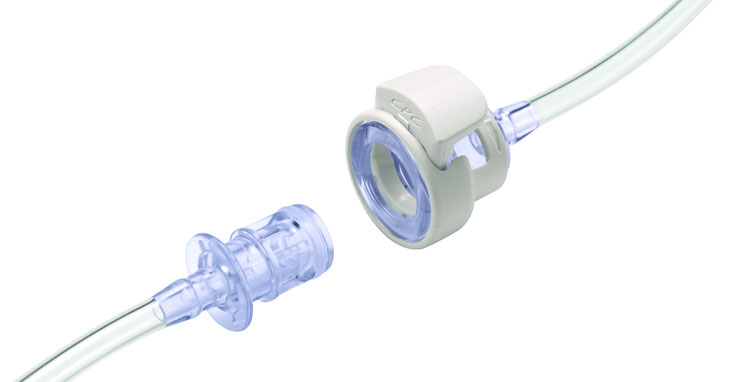
Quick-disconnect fittings use a push-to-connect or latch mechanism that allows for rapid, tool-free connection and disconnection of fluid lines, minimizing downtime and risk of contamination during equipment changeover or maintenance. The design typically consists of a male (insert) and female (body) coupling, with a spring-loaded or mechanical locking mechanism that ensures a secure, leak-tight seal under rated pressure conditions. Many quick-disconnects are engineered with integrated shutoff valves—either in one or both halves—to automatically stop flow when disconnected, preventing fluid loss and air ingress. These fittings are available in a variety of materials suited for chemical compatibility and sterilization requirements, including polypropylene, polycarbonate, acetal, and stainless steel. Connection end options include barbed, sanitary, or threaded terminations, making them adaptable for use in bioprocessing, laboratory, industrial, and OEM applications.
Components:
- Male and female coupling halves
- Locking mechanism (latch or push-to-connect)
- Optional shut-off valve
Advantages and Disadvantages of Quick-Disconnect Fittings
| Advantages | Disadvantages |
| Allows for quick and easy tubing changes | Higher cost than other fittings |
| Minimizes downtime | May require specific mating parts |
| Available in sterile options | Some designs can restrict flow |
Applications
- Biopharmaceutical manufacturing and processing
- Beverage dispensing and food production systems
- Industrial fluid handling systems requiring frequent changes
- Cooling systems for electronics and laser applications
Sanitary Fittings
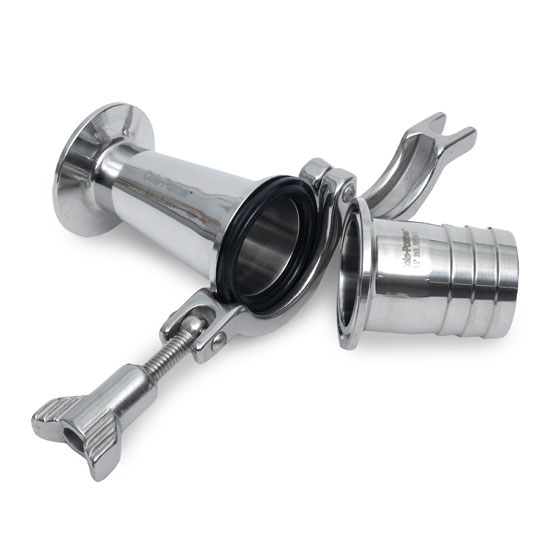
Sanitary fittings, also known as Tri-Clamp fittings, are designed to prevent contamination by featuring smooth, crevice-free surfaces that facilitate easy cleaning. In sanitary fittings, the three main components—the ferrules, or flanged mating ends, gasket, and clamp—work together to form a secure, contamination-free connection. The ferrules provide the structure and are available with various end configurations such as barbs or other Tri-Clamps, the gasket creates a seal between mating surfaces to prevent leaks, and the clamp holds the components tightly together, ensuring a reliable and hygienic connection that can withstand cleaning and sterilization processes.
Components:
- Ferrules (flanged mating ends)
- Clamp
- Gasket
Advantages and Disadvantages of Sanitary Fittings
| Advantages | Disadvantages |
| Easy to clean and prevents contamination | Higher cost |
| Meets FDA and USP regulations | Requires proper gasket alignment to avoid leaks |
| Ideal for sterile environments | Bulkier than other fitting types |
Applications
- Dairy, food, and beverage processing
- Biopharmaceutical and medical research applications requiring sterile connections
- High-purity water systems
- Cosmetic and personal care product manufacturing
Threaded Fittings

Threaded fittings are commonly used to create secure, durable connections in piping systems or equipment attachment for fluid and gas transfer. These fittings feature internal or external threads that screw into corresponding threaded components, such as pipes, hoses, or valves, to form a tight seal. These fittings come in different sizes and thread standards, such as NPT (National Pipe Thread) or BSP (British Standard Pipe), that can be tapered or parallel. While they provide a reliable, reusable seal, threaded fittings can require additional sealing methods, like thread tape or sealant, to ensure proper sealing and prevent leaks.
Components:
- Male-threaded end
- Female-threaded end
- Optional sealant (PTFE tape or thread sealant compound)
Advantages and Disadvantages of Threaded Fittings
| Advantages | Disadvantages |
| Strong and durable connection | Prone to leaks if not properly installed |
| Works with various materials | Risk of galling with certain metals |
| Suitable for high-pressure applications | May require sealants like PTFE tape |
Applications
- Plumbing and industrial piping systems
- Hydraulic and pneumatic fluid transfer
- High-pressure chemical processing systems
- Oil and gas industry connections
FAQ
Q: What factors should I consider when choosing a fitting type?
A: Key considerations include pressure requirements, compatibility with tubing material and durometer, sterility needs, ease of installation, and the need for reusability. To determine fitting material chemical compatibility, utilize the Cole-Parmer chemical compatibility database.
Q: How do I prevent leaks in fluid fittings?
A: To prevent leaks in fluid fittings, ensure that all connections are properly tightened, use the correct seals or gaskets for the fitting type, and apply thread sealant or tape, when necessary, especially for threaded fittings. Regularly inspect the fittings for wear or damage and replace any worn components to maintain a secure seal.
Q: Can quick-disconnect fittings handle high pressure?
A: Quick-disconnect fittings are generally not designed for high-pressure applications, as their primary function is ease of use and quick maintenance rather than withstanding extreme pressure. While they are reliable for low to moderate pressure systems, they may leak or become damaged under high-pressure conditions.
Q: Why are sanitary fittings used in food and pharmaceutical industries?
A: Sanitary fittings are used in the food and pharmaceutical industries because their smooth, crevice-free design ensures easy cleaning and sterilization through Clean-In-Place (CIP) and Sterilize-In-Place (SIP) processes, preventing contamination and maintaining hygiene standards. These fittings provide leak-proof connections that are essential for maintaining product quality and safety in these sensitive environments.
Make the Right Fitting Choice for Your Need
Quick-disconnect, sanitary, and threaded fittings each offer critical advantages depending on your system's needs—from fast changeovers and sterile processing to high-pressure durability. Choosing the right fitting ensures that your operations run smoothly, safely, and efficiently.
Looking for additional fitting types? Don't miss Part 1 of this series, where we discuss barbed, compression, and Luer fittings—great options for cost savings, secure seals, and precise control in lab and industrial setups.
Take the next step toward optimizing your fluid handling processes—browse our full range of fittings now.


