Selecting the right fitting for your fluid handling system is critical to achieving safe, efficient, and leak-free performance. With a wide variety of fitting types available, it’s important to understand how each performs under specific application conditions—like pressure, sterility, and compatibility. This article (Part 1 of a 2-part series) explores three common types of fittings: barbed, compression, and Luer fittings. In Part 2, we’ll cover quick-disconnect, sanitary, and threaded fittings.
Overview of Different Fitting Types
Each type of fitting has distinct characteristics that make it suitable for different applications:
- Barbed Fittings: Feature ends with ridges that grip tubing securely, often used with hose clamps for added security. Ideal for use with flexible tubing in low-pressure applications that require cost-effective solutions.
- Compression Fittings: Utilize a nut and ferrule to create a strong, leak-proof connection. Best suited for rigid tubing and high-pressure systems.
- Luer Fittings: Standardized small-scale fittings with a conical taper that are available in male and female interlocking configurations. Commonly used in research and laboratory applications.
- Quick-Disconnect Fittings: Enable fast and easy tubing changes with a push-to-connect or latch mechanism. Often used in upstream and downstream bioprocessing setups.
- Sanitary Fittings: Designed for sterile applications, these fittings use clamps and gaskets to ensure contamination-free connections in food and pharmaceutical industries.
- Threaded Fittings: Secure fittings with screw-threaded ends that provide a durable, high-strength connection. Used across industrial, plumbing, and hydraulic systems.
Pros and Cons of Different Fitting Types
| Fitting Type | Advantages | Disadvantages |
| Barbed | Simple installation, cost-effective, widely used and available | Not ideal for high pressure, potential for leaks |
| Compression | Strong, leak-proof, good for high-pressure systems | Requires precise installation, not easily reusable |
| Luer | Standardized, easy to connect, precise fluid control | Limited to low-pressure applications, small bore sizes |
| Quick-Disconnect | Fast changes, minimizes downtime, sterile options, integrated shut-off valve options | Higher cost, may require specific mating parts |
| Sanitary | Easy to clean, prevents contamination, regulatory compliant | Higher cost, multiple components required, requires proper gasket alignment |
| Threaded | Strong, durable, reusable, industry standard threads | Prone to leaks if improperly installed, galling potential, more difficult to clean |
Barbed Fittings
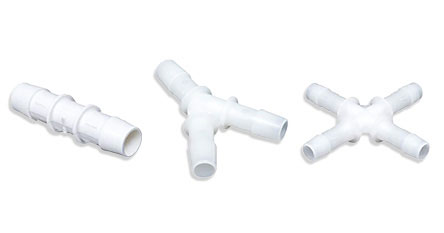
Barbed fittings, also known as hose barb fittings or hose connectors, are commonly used to join flexible tubing, and feature a ribbed or ridged design that grips tubing securely. These ridges, also referred to as barbs, grip the inside of the tubing, preventing it from slipping off. Barbed fittings are typically sized based on the inner diameter (ID) of the flexible tubing they are going to be used with. For example, a 1/4" barbed fitting is intended to fit tubing with a 1/4" inner diameter. Ensuring the correct match between the fitting size and the tubing ID is essential for a secure, leak-free connection. While barbed fittings are easy to install and low-cost, they do require careful attention to prevent issues such as leaks, which can occur if the tubing is not properly secured or if the fitting is used with the wrong type of tubing. A hose clamp, also referred to as a tubing clamp, or crimp ring is often used to further secure the connection and minimize leaks.
Advantages and Disadvantages of Barbed Fittings
| Advantages | Disadvantages |
| Simple to install, no tools required | Not suitable for high-pressure applications |
| Cost-effective | Potential for leaks if not properly secured |
| Versatile and widely available | May require hose clamps for extra security |
Applications
- Low-pressure liquid and gas transfer in laboratory and industrial applications
- Home aquarium systems and irrigation
- Academic and pharmaceutical tubing connections
- Automotive fluid systems
Compression Fittings

Compression fittings are used to create secure, leak-proof connections between pipes or rigid tubing. These fittings consist of a few key components including a compression nut, ferrules (or sleeves), and a fitting body. When the nut is tightened, it compresses the ferrule around the tubing, forming a tight seal. Compression fittings are typically sized based on the outer diameter (OD) of the rigid tubing they are designed to connect. For example, a 1/8" compression fitting is meant to fit tubing with a 1/8" outer diameter. This makes proper sizing critical to ensure a secure, leak-free connection. These fittings are ideal for rigid tubing materials like metal and hard plastic. The design allows for a tight seal even under moderate to high-pressure conditions. Compression fittings are not easily reusable, as the ferrule can become deformed when the nut is tightened.
Components
- Compression Nut
- Ferrules (metal or plastic ring)
- Fitting Body
Advantages and Disadvantages of Compression Fittings
| Advantages | Disadvantages |
| Provides a strong, leak-proof seal | Requires precise installation |
| Works well with rigid tubing | Not easily reusable |
| Good for high-pressure gas and liquid applications | Can be more expensive than barbed fittings |
Applications
- High-pressure fluid and gas systems in industrial settings
- Laboratory and analytical instruments requiring secure connections with rigid tubing (e.g., chromatography)
- Water and fuel lines in automotive and aerospace applications
- Hydraulic and pneumatic systems
Luer Fittings
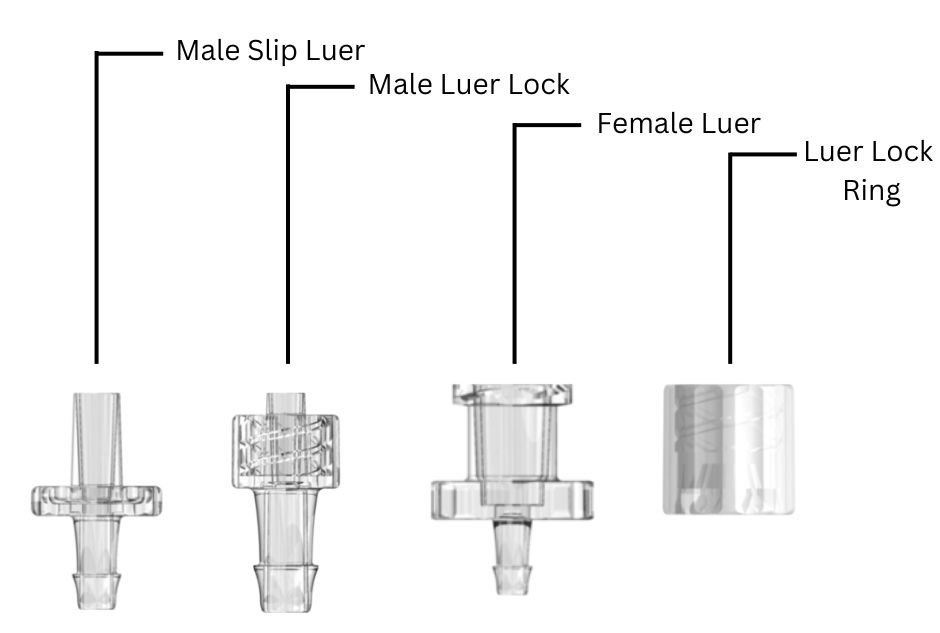
Luer fittings are standardized small-scale fittings commonly used to join syringes, tubing, and other components in fluid and gas transfer applications through a conical taper. These fittings are available in two main styles: Luer Slip and Luer Lock. Luer Slip fittings simply slide together, while Luer Lock fittings have a twist-and-lock mechanism to prevent accidental disconnection. There are two fitting configurations, including male and female, which are designed to fit together securely. The male Luer has a tapered, external conical shape that inserts into a female Luer, which features an internal taper or a threaded mechanism for a secure connection. This male-to-female connection works for both Luer Slip (push-fit) and Luer Lock (twist-and-lock) styles. The standardized taper ensures compatibility across components when they follow ISO standards (like ISO 594 or ISO 80369, depending on application). Luer fittings are designed to provide a quick and reliable connection for low-pressure fluid or gas transfer, with a simple and compact design that allows for easy assembly and disassembly.
Components
- Male Luer
- Female Luer
- Optional Locking Ring
Advantages and Disadvantages of Luer Fittings
| Advantages | Disadvantages |
| Standardized and easy to connect | Limited to low-pressure applications |
| Small, compact footprint for tight spaces | Typically available only in small bore sizes |
| Leak-free when properly mated | Not suitable for industrial fluid transfer |
Applications
- Micro and nano flow devices such as syringes and syringe pumps
- Pharmaceutical fluid transfer
- Analytical laboratory equipment (e.g., chromatography and microfluidics)
- Biotechnology applications requiring precise dosing
FAQ
Q: What factors should I consider when choosing a fitting type?
A: Key considerations include pressure requirements, compatibility with tubing material and durometer, sterility needs, ease of installation, and the need for reusability. To determine fitting material chemical compatibility, utilize the Cole-Parmer chemical compatibility database.
Q: Are compression fittings reusable?
A: Compression fittings are typically not reusable because the ferrule deforms upon installation, making it difficult to achieve a proper seal upon reuse.
Q: What is the difference between Luer lock and Luer slip fittings?
A: Luer lock fittings twist and secure in place, providing a more secure connection, while Luer slip fittings rely on a simple push-fit mechanism.
Make the Right Fitting Choice for Your Need
Understanding the unique strengths of barbed, compression, and Luer fittings helps you make informed choices for your fluid handling setup. Whether you need the cost-effectiveness of barbed fittings, the high-pressure performance of compression types, or the precision and standardization of Luer connectors, selecting the right option ensures reliable and efficient operation.
Still exploring your options? Be sure to check out Part 2 of this series, where we cover quick-disconnect, sanitary, and threaded fittings—ideal for systems that require easy maintenance, cleanability, or heavy-duty performance.
Take the next step toward optimizing your fluid handling processes—browse our full range of fittings now.
References


